November 23rd, 2026
Instructors and leaders from Taiwan and Hong Kong joined the ITF TALKS with the Children Development Committee and committee representatives for a dedicated ITF Open Talks session focused on child-centered pedagogy, safe competition preparation, and family engagement.
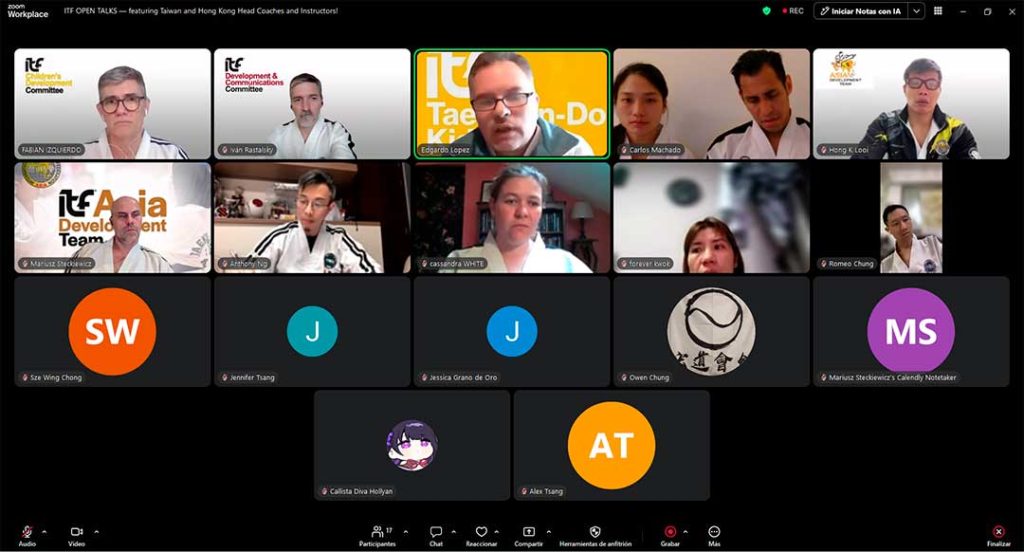
The forum was organized by Sabum Carlos Machado (International Taekwon-Do Federation Chinese Taipei Association) in coordination with Master Anthony Ng (Hong Kong International Taekwon-Do Alliance), with technical coordination by Sabum Ivan Rastalsky and translation between Spanish and English by Sabum Edgardo Lopez.
National leadership was represented by Sabum Howard Hu, President of the ITF Chinese Taipei Association, and Sabum Chun Man Leung, President of the Hong Kong International Taekwon-Do Alliance. Participating ITF committee officials included Master Fabián Izquierdo (Chairman, Children’s Development Committee), Master Mariusz Steckiewicz (Member, Asian Development Team), Master Hong Looi (Chairman, Athlete Committee), Sabum Cassandra White (Member, Women’s Committee), and Boo Sabum Yu-Shih Lin (Member, Women’s Committee).
Ahead of the session, Sabum Carlos Machado compiled feedback from club coaches across both territories. While coaches in both regions reported that intense early academic pressures restrict student schedules and retention, their primary operational hurdles differ:
• Hong Kong: Instructors face a shrinking youth demographic and a lack of official government status.
• Taiwan: Instructors navigate classroom-level challenges, particularly in supporting special needs students and balancing technical precision with student motivation.
Coaches across both associations emphasized the need for standardized youth guidelines, specialized coaching workshops, and stronger public promotion.
During the informal exchange, participants explored a wide range of practical and institutional subjects:
• Local Adaptation Over a Universal Syllabus: Tracing the evolution of children’s programs from Taekwon-Do’s military roots, Master Fabián Izquierdo emphasized that his work establishes an ITF child education and protection policy rather than a rigid global curriculum. He recommended forming local children’s committees to develop culturally appropriate programs tailored to Taiwan and Hong Kong.
• Educational Differentiation & Study Pathways: To compete with state-supported combat sports and demographic shifts, Master Izquierdo advised positioning dojangs as formative educational schools rather than pure athlete factories. He outlined three structured study pathways (ages 3–8, colored belts, and black belts) supported by report cards, focusing early assessment on fundamental movement abilities and requiring long-term instructor training in pedagogy and psychology.
• School Partnerships & Relieving Academic Pressure: Addressing the long school and study hours in Taiwan and Hong Kong, discussions covered integrating Taekwon-Do into school curricula as an educational ally that builds attention, memory, and concentration through playful, structured classes without adding extra burden to family routines.
• Competition Readiness & Concussion Prevention: Addressing concerns that youth compete under adult-oriented rules without sufficient emotional preparation, Master Izquierdo noted ongoing rule reviews with the Umpire Committee. Master Hong K. Looi highlighted World Cup debrief findings showing that pre-juniors recorded the highest concussion rates across categories, calling for dedicated psychological preparation and concussion policies.
• Skills-and-Games Festivals & Post-Elimination Play: Master Izquierdo shared how preparatory skills-and-games events—designed around developed ability and maturity rather than chronological age, height, or weight alone—helped virtually eliminate post-tournament youth dropout in his experience. Participants also discussed running skills activities alongside traditional tournaments so eliminated children remain engaged and families see greater value.
• Healthy Coaching & Parent Communication: Master Mariusz Steckiewicz reinforced framing early club and friendly competitions around learning, friendship, and personal goals rather than medals, warning against emotionally harmful coaching. Participants also stressed holding regular parent meetings to clearly explain learning objectives, grading standards, and progression timelines.
Participants concluded with a shared commitment to ongoing collaboration and locally adapted implementation across Taiwan and Hong Kong. A continue deepening of training in child development, in accordance with the ITF guidelines promoted by this Committee.
 19th INTERNATIONAL DO COURSE – Report